
Troubleshoot AC Not Cooling: Step-by-Step Diagnostic Guide

Table of Contents
Why Your AC Isn't Cooling: Common Causes
Step 1: Check Your Thermostat Settings and Temperature
Step 2: Inspect Your Air Filter and Airflow
Dirty or clogged air filters and restricted airflow
Step 3: Examine the Outdoor Condenser Unit
AC Running But Not Cooling: Refrigerant and Electrical Issues
Separate what you can check from what you cannot
Low refrigerant or a refrigerant leak
Electrical problems and a tripped circuit breaker
When the air is cold but the house still feels warm
How to Reset AC Not Cooling: Safe Reset Procedures
Frozen AC Coil Troubleshooting and Prevention
Thaw the coil safely
Why the coil keeps freezing: the airflow side competitors skip
Prevent repeat freeze-ups
AC Troubleshooting Checklist and When to Call a Technician
Frequently Asked Questions
Last Updated: October 16, 2026
Why Your AC Isn't Cooling: Common Causes
Most problems stem from simple fixes like dirty filters or thermostat errors; others need a pro.
You can often identify the problem yourself. Start with the easiest checks and work toward complex diagnostics, this saves time and helps you describe the issue to a technician.
Common causes include thermostat settings, clogged filters, blocked condenser units, refrigerant leaks, electrical problems, and compressor or fan failures.
Step 1: Check Your Thermostat Settings and Temperature
Before assuming your AC is broken, verify the thermostat settings.
Check these details:
Mode setting: The thermostat must be in "cool" mode, not "off," "heat," or "fan only"
Temperature setting: Set the desired temperature at least 3 degrees below the current room temperature
System switch: Confirm the switch is set to "cool" or "auto," not "off"
If your thermostat uses batteries, replace them. A low battery can prevent the system from communicating with your AC unit. Some thermostats need recalibration if they're reading room temperature incorrectly.
Lower the setting by 5 degrees and wait 15 minutes. If cool air flows, the thermostat was set too high. If nothing changes, move to the next step.
Pro Tip If you have a programmable or smart thermostat, check the schedule. Your system might be in a programmed "off" period. Override the schedule temporarily to test whether the AC works when manually set to cool.
Step 2: Inspect Your Air Filter and Airflow
A clogged air filter restricts airflow and is the most common reason AC units run but don't cool properly.

Dirty or clogged air filters and restricted airflow
Check the filter:
Hold it up to light. If you can't see light through it, it's clogged
Look for visible dust, pet hair, or debris buildup
Note the filter size printed on the frame (common sizes: 16x25x1, 20x25x1, 16x25x4)
A dirty filter forces your system to work harder, reducing cooling capacity; severely restricted airflow can even freeze the evaporator coil.
Replace the filter if it looks dirty, most need replacement every 1 to 3 months, depending on pets, dust, and filter type.
After replacing the filter, ensure vents are open and unobstructed, closed vents reduce airflow and make cooling uneven.
Watch Out Never run your system without a filter. A missing filter allows dust to coat your evaporator coil and compressor, causing expensive damage. Always install a replacement immediately.
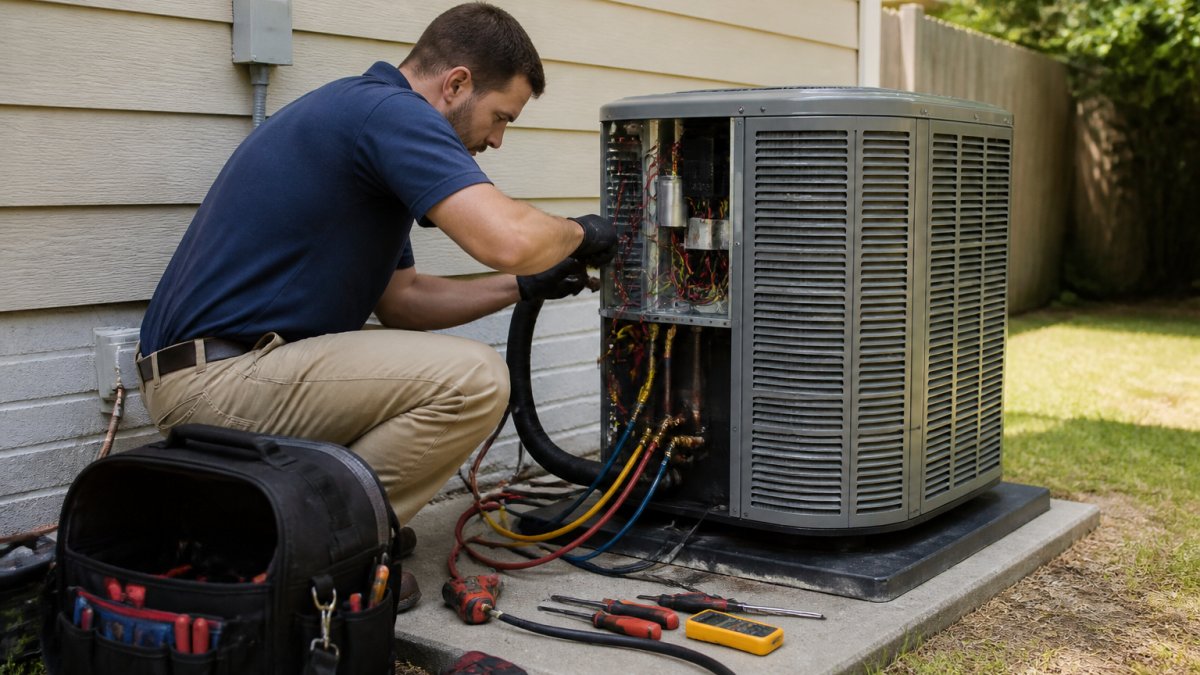
Step 3: Examine the Outdoor Condenser Unit
Your outdoor condenser releases heat from your home. If it's blocked or dirty, the cooling cycle can't complete.
Check for these issues:
Debris around the unit: Remove leaves, grass, dirt, and branches within 2 feet of the unit
Blocked fins: Look at the metal fins (thin vertical blades). If they're clogged with dirt or lint, clean them gently with a soft brush or vacuum
Refrigerant lines: Ensure copper lines running from the unit aren't kinked or damaged
Clear vegetation around the condenser. Bushes, vines, and tall grass reduce airflow.
For light cleaning, use a soft brush or cloth; for heavier buildup, a garden hose on low pressure.
If the condenser looks clean but your system still isn't cooling, the issue likely involves refrigerant or electrical components.
AC Running But Not Cooling: Refrigerant and Electrical Issues
When the system runs but the air never gets cold, the fault usually sits in the refrigerant circuit or electrical components. Both require a licensed technician, but you can narrow the problem safely first. Work through the checks below in order and stop at any stop point.
Separate what you can check from what you cannot
Safe for a homeowner:
Thermostat mode, setpoint, and schedule
Air filter condition and correct size
Breaker position and the outdoor disconnect switch
Stop point, do not proceed, call a technician:
Any suspected refrigerant leak
Any breaker that trips more than once
Ice that returns after a filter change
Low refrigerant or a refrigerant leak
Refrigerant absorbs heat from indoor air and releases it outdoors. If the charge is low, the system can't move enough heat, so it runs long and still misses the setpoint.
Signs of low refrigerant include:
Cool air from vents, but not cold enough to reach the setpoint
Ice forming on the refrigerant lines or the outdoor unit
System running constantly without cycling off
Refrigerant doesn't get "used up" like fuel, a low charge means a leak exists (the EPA).
Never add refrigerant yourself. Overcharging or using the wrong type damages the compressor, and that repair costs far more than fixing the leak.
Electrical problems and a tripped circuit breaker
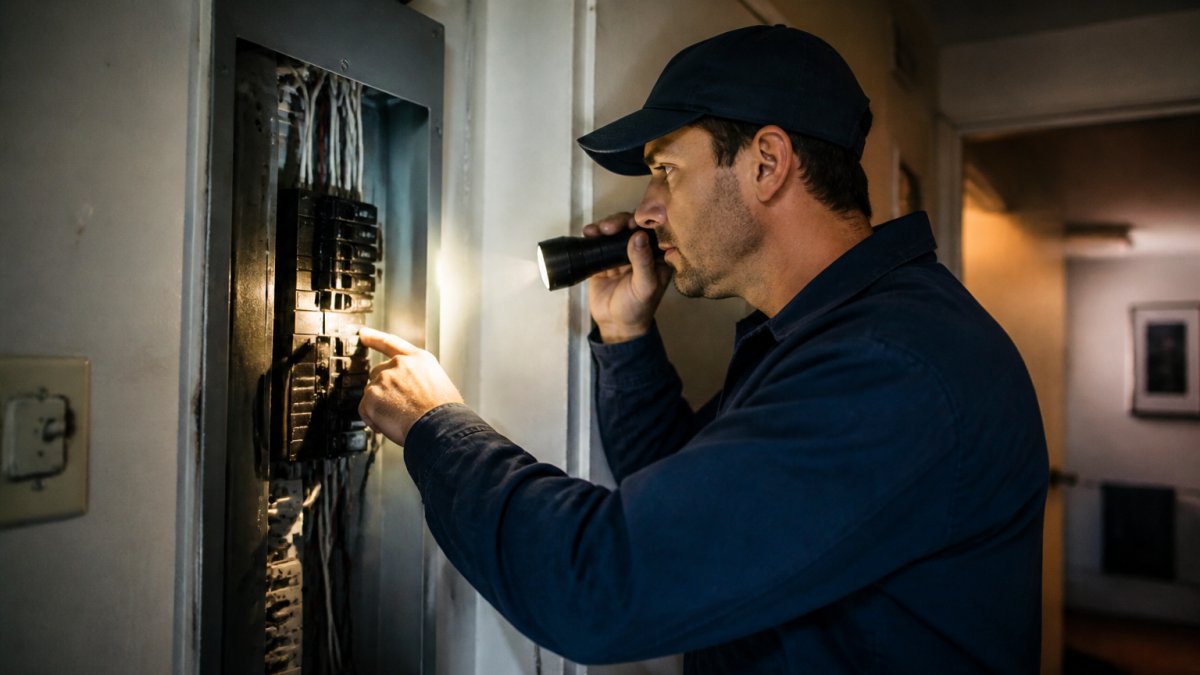
Your system uses two circuits: one for the indoor air handler and one for the outdoor condenser. If either breaker trips, part or all of the system stops.
Check your electrical panel:
Locate the breakers labeled for the AC or cooling equipment
Look for a breaker in the "off" position or sitting between "on" and "off"
If a breaker is tripped, switch it fully off, then back on
If the breaker won't stay on, don't keep resetting it, repeated tripping points to a short, a failing compressor, or an undersized or damaged circuit. Contact a professional.
Also check the outdoor disconnect switch, a small box near the condenser.
Key Takeaway A breaker that resets and holds usually means the system was overloaded once and is now fine. A breaker that trips repeatedly means an electrician needs to inspect the circuit and the equipment.
When the air is cold but the house still feels warm
If the vents blow cold air and the thermostat still won't satisfy, the equipment may not be the problem. Three factors commonly cause this:
Humidity. A system that removes heat but not enough moisture leaves the air feeling clammy. High indoor humidity makes a room feel warmer than the thermostat reads. A system that is oversized for the home can short-cycle and never run long enough to dehumidify.
Heat load. West- and south-facing rooms, upper floors, and rooms over garages gain more heat than the rest of the house. On a hot afternoon, those rooms can run several degrees warmer even with a correctly sized system.
Airflow balance. Closed vents, blocked returns, and leaky ducts starve some rooms of conditioned air while over-supplying others.
A quick check: after the system runs 15 minutes, compare the temperature at a return grille with a supply register in the same room. If supply air is only slightly cooler than the return, the equipment may not be cooling properly.
If you suspect a refrigerant leak, repeated breaker trips, or ice that keeps returning, stop troubleshooting and call a licensed technician. These conditions can damage the compressor if the system keeps running.
How to Reset AC Not Cooling: Safe Reset Procedures
A system reset can resolve minor issues without service. It's different from restarting.
Here's how to safely reset your AC:
Turn off the thermostat: Set it to "off" mode
Switch off the breaker: Go to your electrical panel and flip the AC breaker to "off"
Wait 5 minutes: This clears the system's memory and capacitors
Turn the breaker back on: Switch it to "on"
Set the thermostat to cool: Wait 5 minutes for the system to initialize
Listen for the outdoor unit to start, you should hear the compressor hum and the fan spin. If nothing happens after 10 minutes, the reset didn't work.
Never reset the system more than once. If it fails after a reset, a technician must diagnose the problem. Repeated resets can damage components.
Frozen AC Coil Troubleshooting and Prevention
A frozen evaporator coil stops your system from cooling. Ice forms when the coil surface drops below freezing, from severely restricted airflow or a low refrigerant charge. The coil is the indoor part of the system, usually inside the air handler or above the furnace.
Signs of a frozen coil:
No cold air from vents even though the system is running
Ice visible on the refrigerant lines or the indoor cabinet
System shuts off after running for 10-15 minutes
Thaw the coil safely
Turn the system off at the thermostat. Running with a frozen coil can damage the compressor.
Check and replace the air filter if dirty. A clogged filter is the most common cause of restricted airflow. Do not run the system without a filter.
Let the coil thaw. Allow 2-4 hours. Do not chip at the ice or use a heat source.
Restart and watch. If the system runs normally, the filter was likely the cause.
If the coil freezes again after a filter change, the cause is usually low refrigerant, a failing blower, or a distribution problem that restricts airflow. All three require professional diagnosis.
Why the coil keeps freezing: the airflow side competitors skip
Most guides stop at the filter, but repeat freeze-ups often trace back to the duct system and return path.
Return-air restrictions. An undersized return, a return grille blocked by furniture, or a filter grille too small for the system starve the coil of air. The coil gets cold, airflow can't carry the heat away, and ice forms.
Closed or blocked supply vents. Closing vents in unused rooms raises static pressure, reducing total airflow across the coil and pushing its temperature below freezing.
Duct leaks. Leaky ducts in an attic or crawlspace pull in hot, humid air that condenses on the cold coil, contributing to ice buildup. Leaks also reduce air reaching rooms, so parts of the home stay warm even when the coil isn't frozen.
If some rooms never get comfortable while others are fine, the freeze-up and uneven cooling likely share a cause: the distribution system. A technician can measure static pressure and airflow to confirm it.
Prevent repeat freeze-ups
Replace air filters every 1-3 months, more often with pets or heavy dust
Keep return grilles and supply vents open and unobstructed
Maintain 2 feet of clearance around the outdoor unit
Watch Out If the coil freezes again after you replace the filter and open the vents, stop running the system. Repeated freeze-ups stress the compressor and can turn a repair into a replacement.
If ice returns, the compressor struggles, or the breaker trips during a thaw cycle, call a licensed technician. These are stop points, keep the system off until it is diagnosed.
AC Troubleshooting Checklist and When to Call a Technician
Use this checklist to work through cooling problems:
Issue | Check | Action |
No cold air | Thermostat mode and temperature | Set to cool, lower temp 5 degrees |
Weak airflow | Air filter and vents | Replace filter, open closed vents |
System won't start | Breaker and disconnect switch | Reset breaker, check disconnect |
Ice on lines | Airflow and filter | Replace filter, wait for thaw |
Constant running | Temperature setting and filter | Verify setting, replace filter |
Outdoor unit quiet | Power and breaker | Check breaker, verify power |
Call a professional technician if:
Your system won't cool after checking thermostat and filter
You suspect a refrigerant leak (hissing sounds, ice buildup)
A circuit breaker trips repeatedly
ACE ELECTRICAL AC & HEATING offers 24/7 emergency AC repair throughout the Greater New Orleans area. Our certified technicians diagnose cooling problems quickly.
When your AC stops cooling, start with the simplest checks: thermostat settings, air filter condition, and outdoor unit clearance. Most homeowners resolve cooling problems with these three steps. For refrigerant, electrical, or frozen-coil issues, professional service prevents costly compressor damage.
Frequently Asked Questions
Why would my AC be running but not cooling the house?
Your AC unit may be running but not cooling due to low refrigerant, a frozen evaporator coil, a failed compressor, or a broken condenser fan motor. Electrical issues like a tripped capacitor can also prevent the cooling cycle from functioning. Check your thermostat is set to cool mode and that your air filter isn't clogged before calling a technician to diagnose mechanical or refrigerant problems.
Can a dirty air filter make an AC stop cooling?
Yes. A clogged air filter severely restricts airflow through your system, reducing cooling performance and potentially causing the evaporator coil to freeze. This blocks cold air from reaching your home. Replace your air filter every 30-90 days depending on pets, dust, and usage. A clean filter is the easiest first step to restore cooling and prevent system damage.
How do I reset my AC if it is not cooling?
Turn off your thermostat and the breaker for your AC unit for 5-10 minutes, then switch both back on. This resets the system safely. If your unit has a reset button on the condenser, press it once. Avoid overriding safety shutoffs; if the problem persists after a reset, the issue is likely mechanical or electrical and requires professional diagnosis.
When should I call an HVAC technician for an AC that is not cooling?
Call a technician immediately if your home temperature exceeds 80°F indoors, you smell burning or chemical odors, you hear grinding or unusual noises from the unit, or your AC runs but blows warm air after you've checked the thermostat, filter, and condenser. Do not delay if you suspect a refrigerant leak or electrical fault; these require licensed professional repair.
Click to Call 504-914-8771

Comments